
The Family Together in Worship
King’s Cross Church Family,
Recently a King’s Cross member who is a parent of young children approached me and asked for any thoughts I had regarding children in the worship service. Having raised three, who all sat with us in worship from a very young age, I have plenty!
What a wonderful question to ask – it goes to the heart of one of our core values as a church: the family together in worship. What I find is that for many parents, the first part of that phrase (the family together) is a lot easier to implement than the second (in worship)! By that, I mean it isn’t hard to bring your children into the worship service; what’s harder is knowing how to actually engage young ones in worship.
I was able to share some quick thoughts with that parent, but have continued to think about the issue for a few days and wanted to write something to the church more broadly. I pray this is useful, not only for our younger families, but for the entire congregation as we embrace the family together in worship.
1. The point is the family together in worship not merely the family together
Involving your children in worship is more than simply having them in the service with you. It means you are actively engaging them, turning their attention to what is occurring, and training them to show reverence to God.
Robbie Castleman wrote a very helpful book on this topic: Parenting in the Pew. The best contribution is rescuing parents from the idea that silent, disinterested children that don’t ever call attention to your family is somehow a metric of success. No, we want kids that are actively engaged in worship. But what that means is that, especially for younger kids, the parents will need to work to engage them in what is going on. Here are some things we found helpful when our children were younger (much of this is drawn from Castleman’s book):
2. Be willing to sacrifice for the sake of your kids
Actively parenting in the pew means you will personally be engaged with the worship service a little less than you are used to. I often have young moms tell me sheepishly they didn’t catch much from my sermon – I always try to assure them they are doing a beautiful work. Life does have seasons – this may not be the season you take extensive notes on the Gospel of Luke.
And a word to fathers – this is a key arena of leadership in your family. Don’t leave this task to your wife while you take those extensive notes, ignoring the parenting going on around you. Your wife shouldn’t be a widow in the pew; she should be a wife whose husband takes primary leadership of the family and personally engages the children. Sometimes a corrective look from Dad, accompanied with an authoritative hand on the shoulder, is all the suddenly sheepish child needs to be reminded to behave. One of the best places for a young child to actively engage in the worship service is the lap of an actively engaged father.
3. Ask for help if you need it
While I was in the pew plenty with my young kids (most of the churches we were in had two services, so even if I preached I sat for another sermon), there were also a lot of Sundays with our little ones where I was preaching and Shelby was doing this on her own. One of our sweet memories is having one of our kids sit with one of our trusted, often a bit older friends in the church. This was usually an older and better trained child, who could be trusted by that point to sit pretty still. The people we asked for this help also understood that they had our permission to verbally correct our kids if they were being disrespectful or distracting, and that we wanted them to tell us if this happened. Some of those families became our closest friends from that era, and were a real help to us in our parenting in other areas as well, even when their input was graciously corrective. The world trains us to be sensitive and prickly about input from others in our parenting; let’s not be like that. Let’s be humble and open to help.
4. Remember to love your neighbors in worship around you
This is more related to the very young ones among us. In God’s providence, we have a smaller worship space and sound carries. It is a blessing to have so many babies in the church, and that will mean more fussing from time to time. This past Sunday I couldn’t help but laugh mid-sermon as a couple of our youngest kiddos seemed to decide to slowly boil over at the exact same moment, creating a sort of cascading harmony (as I said in the moment, it really was quite cute). The sound of babies is a blessing, a sign of life and health in a church! And sometimes, like this past Sunday, a kid is going to come out of nowhere and audition for the opera. Not much you can do about that. But we do need to be aware that prolonged, loud crying is a real distraction for the rest of the congregation.
Now, this love for neighbor flows both ways. The congregation needs to be very gracious with young families – and I believe they are. What our young families can do is consider when it is kind to take a very loud child out of the service until they have calmed down. If this is something you feel you need some guidance on (or help calibrating accurately), please come talk with me about it. You won’t receive judgment – just some practical counsel and an understanding Pastor who has been there, and had to navigate all these same challenges.
5. Consider how the rest of life relates to training for worship
We have a training chapel set aside for this very use, especially for families trying to make a transition to this sort of worship environment, either because their kids are just old enough to engage or they are new to a church that doesn’t (and won’t) have a separate “children’s church.” I already mentioned the Children’s Bulletin. We also provide a nursery for kids three and under. This can be a real help, especially if you have several children – an opportunity perhaps to have the youngest one (who tends to get very little out of the sermon) cared for while you focus on training the older kids. While the use of the nursery (and all these resources) is optional, I would welcome a conversation with any who are hesitant to use it, for whatever reason. It is provided as a ministry to our young families.
7. Be assured of much grace
We understand very well that many coming to King’s Cross may be coming from backgrounds where Children’s Church, stretching sometimes to the teen years, is the easy answer. That’s out of keeping with how we think about worship, about families, and about children. But that doesn’t mean there isn’t much grace for families as they make this transition, or grow into this as young parents. We want to be a church that does two things: meets people where they are at, including those totally unacquainted with our approach to the family together in worship, or struggling to adjust into this stage of parenting. But we also want to be a church that helps people not stay in those places. We want to be a community of gracious growth, humbly helping one another to follow Christ, and fostering a worship environment that blesses all the community, from the cradle to glory.
The best two practical resources I am aware of are Parenting in the Pew, and also an article by John and Noël Piper: “The Family Together in God’s Presence.” I recommend both for those desiring to go beyond this short letter.
In Christ,
Pastor Nick
Recently a King’s Cross member who is a parent of young children approached me and asked for any thoughts I had regarding children in the worship service. Having raised three, who all sat with us in worship from a very young age, I have plenty!
What a wonderful question to ask – it goes to the heart of one of our core values as a church: the family together in worship. What I find is that for many parents, the first part of that phrase (the family together) is a lot easier to implement than the second (in worship)! By that, I mean it isn’t hard to bring your children into the worship service; what’s harder is knowing how to actually engage young ones in worship.
I was able to share some quick thoughts with that parent, but have continued to think about the issue for a few days and wanted to write something to the church more broadly. I pray this is useful, not only for our younger families, but for the entire congregation as we embrace the family together in worship.
1. The point is the family together in worship not merely the family together
Involving your children in worship is more than simply having them in the service with you. It means you are actively engaging them, turning their attention to what is occurring, and training them to show reverence to God.
Robbie Castleman wrote a very helpful book on this topic: Parenting in the Pew. The best contribution is rescuing parents from the idea that silent, disinterested children that don’t ever call attention to your family is somehow a metric of success. No, we want kids that are actively engaged in worship. But what that means is that, especially for younger kids, the parents will need to work to engage them in what is going on. Here are some things we found helpful when our children were younger (much of this is drawn from Castleman’s book):
- Make use of printed words. Point to the words on the page of the song sheet or in the hymnal in rhythm with the singing. Involve your kids in this – help them drag their finger across the pages of the Bible while the Pastor reads (added bonus: you’re teaching them to read!). This works in all the printed words of the service.
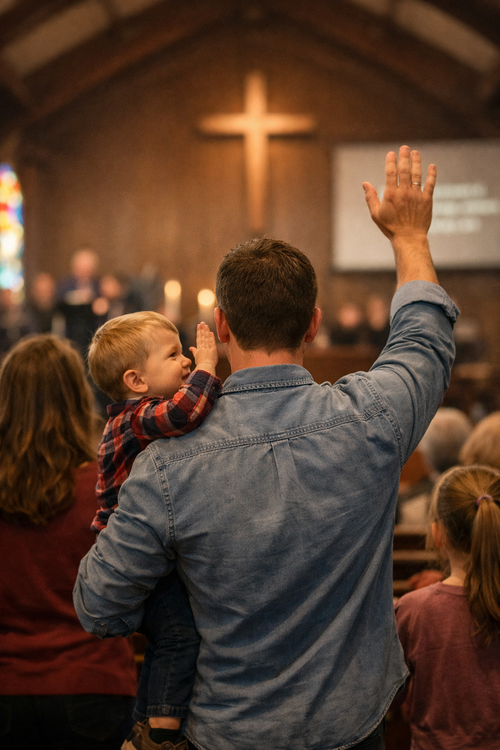
- Train them to physically engage in the acts of worship. Stand together with the congregation. If you kneel for confession, have your kids kneel with you. One of the sweet views from the back of the sanctuary is when parents raise their hands for the Doxology and their little children follow along. A physically active worship service like ours is actually easier to engage in for children.
- Insist on respectful attention to the service and appropriate behavior. While allowance should be made for children to be childish (they are, after all, children), they typically are capable of more than we think. Failure to sit quietly and respectfully during preaching and other moments of the service was a matter of disobedience in our family, which sometimes required discipline (in a manner fit to the age and abilities of the child). If you are shushing or otherwise instructing your child and they are not obeying you, that is a discipline issue. Parents must train their children to obey the first time they are told, not only after multiple requests, if at all.
- I don’t recommend bringing toys or other distractions to worship. I understand the appeal, but the point of the family together in worship is that worship is occurring, not play. Now, a child young enough to truly not grasp what’s going on will often benefit from some quiet object to help hold their attention – that’s not what I’m talking about. I’m talking about kids who are 4, 5, or older still relying on distractions, or any loud or congregationally distracting objects in worship, at any age.
- A pad of paper and pen, however, is a great tool for engagement, and some pictures being drawn is a pretty gracious way to allow kids to keep their fingers busy. If they’re drawing, consider encouraging them to draw something related to the sermon. And then tell them to go show the preacher – I guarantee, he’ll love it!
- Don’t be shy about verbally interacting! This is critical, and one of the best ways to train children to engage in worship (this is the heart of Parenting in the Pew). This can look like leaning in and quietly whispering to them, “Did you hear that? Jesus is the Son of God! That’s so wonderful!” This isn’t loud (be mindful of not unduly distracting those around you), but it is verbal and purposeful. Resist getting drawn into full-blown conversations – these are small verbal prompts to keep them engaged, and short reactions from them are appropriate, but it’s not the time for an in-depth theological discussion.
- Keep those verbal interactions focused on drawing your kids into worship. Rather than respond to a child’s off-topic questions or exclamations, use those interactions to point them back toward the worship service. This is not the time for a conversation about unrelated things, and a child instigating that talk should be corrected and guided back toward the service.
- Maintain a calm demeanor. If you match their energy when they are fidgety and restless it will spin them up even more. Be calm, especially when giving correction to a distracted child.
- Be wise about potential distractions. Is there something fascinating outside the window, crying out for comment? It might be better to not sit right by that window. Is little Billy always vocally excited to see little Susie? Consider not sitting right next to or behind little Susie’s family, as it will be all the more difficult for them both. This can apply to siblings also. When they were young, we typically found it most useful not to line up our three kids in their own section, but rather to stagger it child-parent-child-parent-child. That allowed for direct parenting of any child, at any moment.
- Use the Children’s Bulletin. Help them fill it out. Make hashmarks with them when the preacher says various words (even kids that don’t read well, or at all, will often start to pick up what’s going on). Have them show it to their Pastor after the service. He loves that.
- Know when to take your child out and address disruptive behavior. This is a matter of kindness for those around you, as well as faithful parenting of your child.
- Know when to be gracious and let things slide. Was it a late night? Let it go this Sunday that your child is stretched out on the pew fast asleep. Is your child doing well and engaging, but after half an hour of preaching starts quietly doodling pictures of dragons or princesses on the margin of the bulletin? Not actually that big of a deal – let it go and reengage next week.
2. Be willing to sacrifice for the sake of your kids
Actively parenting in the pew means you will personally be engaged with the worship service a little less than you are used to. I often have young moms tell me sheepishly they didn’t catch much from my sermon – I always try to assure them they are doing a beautiful work. Life does have seasons – this may not be the season you take extensive notes on the Gospel of Luke.
And a word to fathers – this is a key arena of leadership in your family. Don’t leave this task to your wife while you take those extensive notes, ignoring the parenting going on around you. Your wife shouldn’t be a widow in the pew; she should be a wife whose husband takes primary leadership of the family and personally engages the children. Sometimes a corrective look from Dad, accompanied with an authoritative hand on the shoulder, is all the suddenly sheepish child needs to be reminded to behave. One of the best places for a young child to actively engage in the worship service is the lap of an actively engaged father.
3. Ask for help if you need it
While I was in the pew plenty with my young kids (most of the churches we were in had two services, so even if I preached I sat for another sermon), there were also a lot of Sundays with our little ones where I was preaching and Shelby was doing this on her own. One of our sweet memories is having one of our kids sit with one of our trusted, often a bit older friends in the church. This was usually an older and better trained child, who could be trusted by that point to sit pretty still. The people we asked for this help also understood that they had our permission to verbally correct our kids if they were being disrespectful or distracting, and that we wanted them to tell us if this happened. Some of those families became our closest friends from that era, and were a real help to us in our parenting in other areas as well, even when their input was graciously corrective. The world trains us to be sensitive and prickly about input from others in our parenting; let’s not be like that. Let’s be humble and open to help.
4. Remember to love your neighbors in worship around you
This is more related to the very young ones among us. In God’s providence, we have a smaller worship space and sound carries. It is a blessing to have so many babies in the church, and that will mean more fussing from time to time. This past Sunday I couldn’t help but laugh mid-sermon as a couple of our youngest kiddos seemed to decide to slowly boil over at the exact same moment, creating a sort of cascading harmony (as I said in the moment, it really was quite cute). The sound of babies is a blessing, a sign of life and health in a church! And sometimes, like this past Sunday, a kid is going to come out of nowhere and audition for the opera. Not much you can do about that. But we do need to be aware that prolonged, loud crying is a real distraction for the rest of the congregation.
Now, this love for neighbor flows both ways. The congregation needs to be very gracious with young families – and I believe they are. What our young families can do is consider when it is kind to take a very loud child out of the service until they have calmed down. If this is something you feel you need some guidance on (or help calibrating accurately), please come talk with me about it. You won’t receive judgment – just some practical counsel and an understanding Pastor who has been there, and had to navigate all these same challenges.
5. Consider how the rest of life relates to training for worship
- Foster a worshipful spirit in all of life. Don’t just marvel at the mountains on a sunny Northwest day – point out to your young kids how glorious it is that God made something so grand. Don’t just enjoy a good story – point out the redemptive themes pointing us to the best story of all: the gospel of Jesus Christ. A worshipful attitude shouldn't be a strange and novel thing your kids only encounter at church.
- Similarly, if your kids only ever are expected to sit still and engage in worship at church, it is unkind to expect them to suddenly transform into well-behaved worshippers in training on Sunday morning. There’s nothing about driving your minivan to church that will radically transform your children into something they are never expected to be in your home. This is a benefit of Family Worship – a regular training opportunity in the home where kids are taught to sit still and engage in worship. Family Worship in the home wonderfully prepares children to worship at church. A massive benefit is using Family Worship to teach hymns and songs regularly sung at King’s Cross. When you do that, they will often get excited to hear those songs at church and will be some of the loudest singers.
- Regarding the service itself, talk about it beforehand. Prepare the kids for what is going to happen. Explain the liturgy to them and how the gospel is related through it every week. Teach them to not just pay attention to the pastoral prayer, but to pray along with it. Teach them about the means of grace of hearing God's Word and how God uses that in their lives. After the service, talk about it some more! Ask questions of them on the way home, or over a Sunday meal: What song do you remember singing? What do you remember from the sermon? What was one main point? Did you learn anything new? This trains the kids (and parents!) to be thoughtful in the worship service, and to not let it just dissipate after the benediction.
We have a training chapel set aside for this very use, especially for families trying to make a transition to this sort of worship environment, either because their kids are just old enough to engage or they are new to a church that doesn’t (and won’t) have a separate “children’s church.” I already mentioned the Children’s Bulletin. We also provide a nursery for kids three and under. This can be a real help, especially if you have several children – an opportunity perhaps to have the youngest one (who tends to get very little out of the sermon) cared for while you focus on training the older kids. While the use of the nursery (and all these resources) is optional, I would welcome a conversation with any who are hesitant to use it, for whatever reason. It is provided as a ministry to our young families.
7. Be assured of much grace
We understand very well that many coming to King’s Cross may be coming from backgrounds where Children’s Church, stretching sometimes to the teen years, is the easy answer. That’s out of keeping with how we think about worship, about families, and about children. But that doesn’t mean there isn’t much grace for families as they make this transition, or grow into this as young parents. We want to be a church that does two things: meets people where they are at, including those totally unacquainted with our approach to the family together in worship, or struggling to adjust into this stage of parenting. But we also want to be a church that helps people not stay in those places. We want to be a community of gracious growth, humbly helping one another to follow Christ, and fostering a worship environment that blesses all the community, from the cradle to glory.
The best two practical resources I am aware of are Parenting in the Pew, and also an article by John and Noël Piper: “The Family Together in God’s Presence.” I recommend both for those desiring to go beyond this short letter.
In Christ,
Pastor Nick
Recent
Archive
2026